
Hair Loss Treatment Order, Fully Explained | Medication, Injections or Hair Transplant: What Comes First? (The Black Plastic Surgery, Daegu)

Hair piling up in the shower drain, a crown that looks unusually bare under the lights. Once hair loss starts to bother you, the first question is usually, "Should I start taking medication now, go straight to a clinic, or even think about a hair transplant?" Hair loss treatment does not have one single right answer; it is a treatment with an order that depends on how far it has progressed. Based on the hair loss treatment materials of The Black Plastic Surgery near Banwoldang Station in Daegu, this article sums up which treatments to consider at each stage, and when.
Key Takeaways
Think of hair loss treatment in the order of ① medication and lifestyle → ② injections and scalp care → ③ hair transplant , and it becomes simple. In the early stage, while hair follicles are still alive, medication and care slow the progression; areas where follicles are gone and hair no longer grows are filled in with a hair transplant. Even after a transplant, it is best to keep up the step 1 and 2 treatments to protect your existing hair.
1. What stage is my hair loss at now?
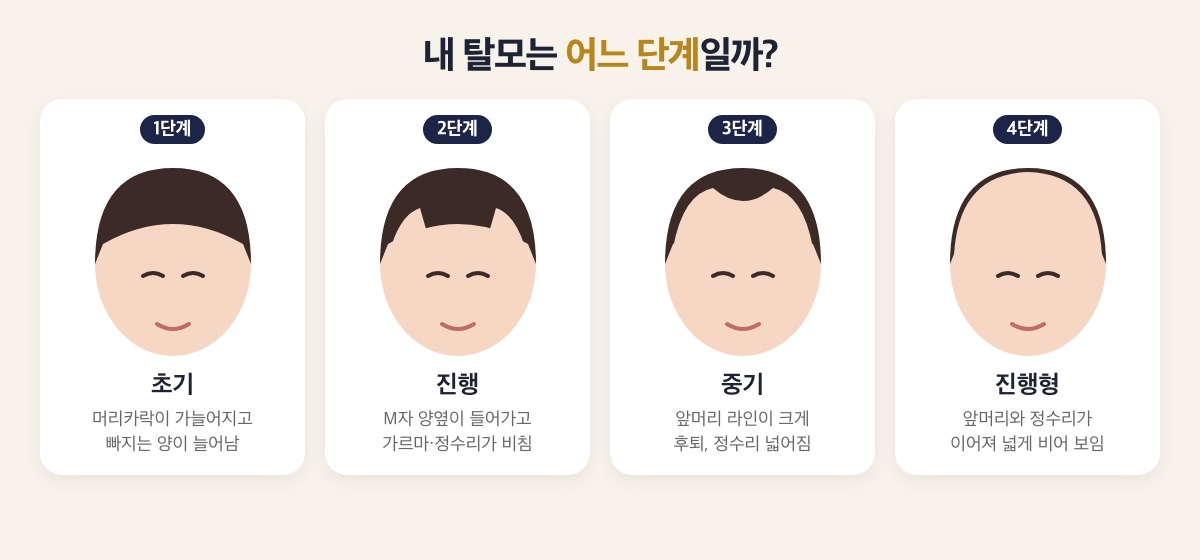
To decide on a treatment order, you first need to know how far your hair loss has progressed. In general, male pattern hair loss starts with thinning hair and spreads to an M-shaped hairline and then the crown, while female pattern hair loss often keeps the hairline relatively intact as density decreases along the part and the crown.
| Stage | Changes you may notice | Treatment to consider first |
|---|---|---|
| Stage 1: Early | Hair becomes thinner and more of it falls out | Medication and lifestyle management |
| Stage 2: Progressing | Both sides of the M-line recede and the scalp shows through at the part and crown | Medication + injections and scalp care |
| Stage 3: Middle | The front hairline recedes and the crown looks widely bare | Medication and injections combined + hair transplant consultation |
| Stage 4: Advanced | Hair loss at the front connects with the crown | Hair transplant + ongoing medication |
2. STEP 1 – Medication and lifestyle
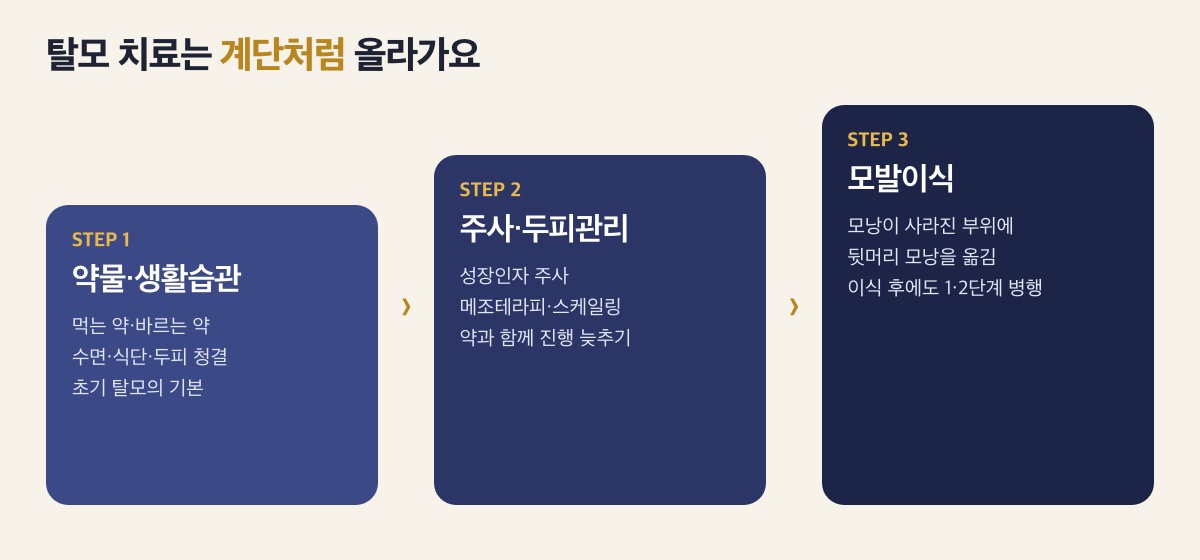
In early hair loss the follicles are still alive, so the most important thing is to slow down the thinning of the hair. For male pattern hair loss, prescription oral medications (finasteride and dutasteride types) and topical medications (minoxidil types) are commonly used. Their effect can usually be judged only after 3 to 6 months or more of consistent use, and because hair loss may progress again if you stop, long-term management is common.
Female hair loss has many possible causes, such as stress, extreme dieting, childbirth, hormonal changes and frequent perms or dyeing, so identifying the cause comes first. Rather than taking men's medication on your own, it is safer to get a medical consultation and treatment suited to the cause. Lifestyle is the foundation, too: enough sleep, a balanced diet with protein, iron and zinc, and shampoo habits that keep the scalp clean all support the effect of treatment.
3. STEP 2 – Injection treatments and scalp care
If medication alone does not stop the progression, or if you have early to middle-stage hair loss and surgery still feels like too much, consider clinic treatments as well. The Black Plastic Surgery offers the following non-surgical treatments.
| Treatment | Description | Best for |
|---|---|---|
| Growth factor injections | Treatment that injects growth factors into the scalp to support follicle nutrition and blood circulation | Early hair loss with thinning hair |
| Mesotherapy | A method of injecting medication directly into the scalp | Those who want to combine it with medication |
| Scalp care (scalp scaling) | Cleans up the scalp environment, such as dead skin and sebum | Seborrheic dermatitis of the scalp, scalp troubles |
| Follicle Strengthening Program | A non-surgical hair loss injection program run by the clinic | Those who want to slow progression before surgery |
Injection treatments do not create new hair in areas where follicles are already gone. Their purpose is to keep the remaining follicles healthy, so they are most meaningful when combined with medication.
4. STEP 3 – When should you consider a hair transplant?
If there are areas where hair no longer grows even with medication and injections, that is the time to consider a hair transplant. A hair transplant is surgery that moves follicles from the back of the head, which is less affected by hair loss, so it is almost the only way to fill areas without follicles. However, you should also check the following conditions.
- Whether you have enough donor follicles at the back of the head: The number of follicles that can be moved is limited, so you need a plan for using them over your lifetime.
- Speed of hair loss progression: If you have a transplant while hair loss is progressing quickly, the untransplanted surrounding hair may keep falling out and look unnatural. Surgery is often done after the progression has been stabilized to some degree with medication.
- The area you want treated: For the front hairline and M-line, design is key; for the crown, direction and density reinforcement are key.
Crown hair transplants: what is different

On the crown, hair grows in a spiral around the hair whorl (crown whorl), so a transplant needs to follow this direction to look natural. Also, crown transplants often add density by planting between the remaining existing hairs, so to keep the existing hair from continuing to fall out, continuing medication alongsideis even more important than with a front hairline transplant. The Black Plastic Surgery plans surgery by hair loss type, such as the O type, where the crown becomes bare in a round shape, and the combined type, where hair is lost at the front as well.
5. Why you should not stop treatment even after a transplant
Transplanted hair keeps the characteristics of the follicles at the back of the head and tends to last relatively long, but untransplanted existing hair may continue to thin. That is why the clinic also presents injection treatments, scalp care and approved hair loss medication after a hair transplant as one management process. In the end, hair loss treatment is not something where steps 1, 2 and 3 finish one after another; it is easier to understand it as a treatment you continue by building up the steps you need.
6. Hair loss self-check list
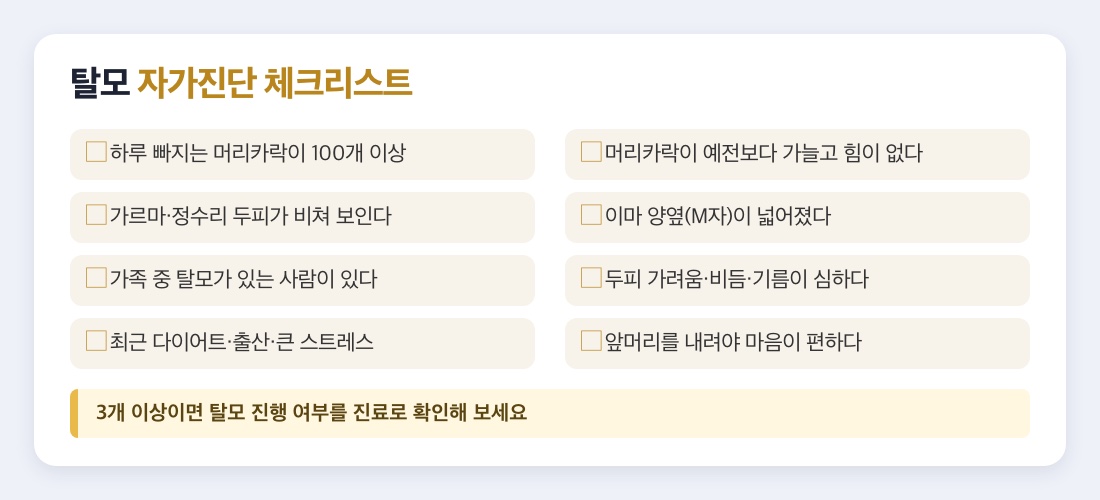
If 3 or more of the items above apply to you, your hair loss may be progressing. The earlier you start, the more hair you can protect, so if you are concerned, get a consultation to check your exact condition.
Frequently Asked Questions
Q. Do I have to take hair loss medication for life?
Hair loss medication slows progression while you take it, so hair loss may progress again if you stop. It is best to decide the duration and method with your medical team, taking into account your hair loss condition and any side effects.
Q. Can injection treatments alone make hair grow back?
The purpose of injection treatments is to keep the remaining follicles healthy. They cannot create new hair in areas where the follicles are already gone, so a hair transplant is considered alongside for those areas.
Q. Is it okay to get a hair transplant in my 20s?
It is possible, but people in their 20s need to be careful because hair loss may progress further. It is best to stabilize the progression with medication first and make a long-term transplant plan before deciding.
Q. Is a crown hair transplant noticeable?
When the hair whorl direction and the density between existing hairs are matched, it tends to blend in naturally. However, if existing hair keeps falling out, density may look low again, so it is important to continue medication alongside.
The Black Plastic Surgery Clinic Information
📍 Address 3rd and 4th floors, Yemian Tower, 2118 Dalgubeol-daero, Jung-gu, Daegu (Line 2, Banwoldang Station Exit 7)
☎️ Phone 053-426-4700
🕘 Hours Mon & Wed 09:00~19:00 / Tue & Fri 09:00~18:00 / Sat 09:00~17:00 (closed Thu, Sun and public holidays)
🩺 Specialties Male and female hair transplants, hairline, crown transplants, non-surgical hair loss treatment
※ This article is written to provide general medical information. Decisions about taking medication or undergoing procedures or surgery must be made after a consultation with a specialist. Any medication or procedure can cause side effects depending on the individual.
Author: BBBManager of the Hospital Encyclopedia cafe · Recording Korean hospital information since 2009
This page was compiled by the author from public information on the hospital's official website and major plastic surgery information platforms. It is independent information, and no payment was received from the hospital. Subscribers can request detailed materials, and the page can also be read in other languages using Chrome's translation feature.

Related postThe Black Plastic Surgery (Daegu Banwoldang Station): Address, Hours and How to Book
Discover more from Hospital & Health Insight Korea
Subscribe to get the latest posts sent to your email.



 Korean
 English
 Japanese
 Chinese (China)
 Chinese (Taiwan)
 French
 Spanish
 Hindi
 Indonesian
 Russian
 Mongolian
 Vietnamese
 Thai
 German
 Turkish
 Portuguese
 Italian
 Polish
 Arabic