
Are Silicone Nose Implants Safe? Side Effects, Exposure and Whether to Remove Them
Silicone implants used in rhinoplasty are a relatively safe material, but that does not mean every patient avoids side effects. A variety of problems can occur, such as the implant being palpable at the nasal tip, the skin thinning until the implant shows through as a white area, or the implant breaking through the skin and becoming exposed.
So does a nose job with a silicone implant always need removal or revision after enough time has passed? The short answer: having a silicone implant does not by itself mean it must be removed after a certain period.What matters is checking your current condition and symptoms and making the decision in consultation with a specialist.

Why Silicone Nose Implants Become Exposed
Problems with silicone implants after rhinoplasty can arise from several factors, including the pressure the implant puts on surrounding tissue and the condition of the skin and soft tissue.
If an implant keeps exerting pressure inside the nose, the nasal tip can be pulled upward, creating an upturned deformity. Conversely, if pressure concentrates in a particular area, the implant can protrude downward or become exposed through tissue that has become relatively weak.
Pay especially close attention if you can feel the implant at the nasal tip, if the skin shows white, or if the skin is thinning.
However, these problems are not an inevitable outcome of every silicone rhinoplasty. The level of risk can vary depending on the implant's shape and size, the surgical method, and the condition of the skin and soft tissue.

Does Silicone Rhinoplasty Become Dangerous Over Time?
In the past, surgery was sometimes performed with one-piece implants that extended all the way to the nasal tip. Today, a range of surgical methods and implant shapes are considered in order to reduce the strain on the nasal tip.
Implant material properties and surgical techniques have also advanced, bringing some improvements over the past. Even so, it cannot be assumed that any particular material or surgical method prevents all side effects.
Having had a silicone implant for 10 years does not mean it must be removed or revised. Some people go a long time without any notable symptoms or problems.
What matters is not simply how much time has passed since surgery, but the current condition of your nose. If you have pain, redness, thinning skin, or implant shifting or exposure, you should see a specialist.
Can Removing a Silicone Nose Implant Restore Your Old Nose?
Removing a silicone implant may not return your nose to exactly how it looked before surgery.
That is because the tissue around the nose may have changed while the implant was in place, and with age, the shape of the facial bones can change along with the skin and soft tissue.
In particular, if the implant has been exposed for a long time, or if inflammation and tissue damage have become severe, the surrounding tissue may be significantly deformed. In such cases, the skin and soft tissue may not fully return to their previous state even after the implant is removed.
On the other hand, when tissue damage is not severe, visible cosmetic problems can be improved through implant removal and any necessary corrective surgery. Even so, the degree of recovery varies with each person's tissue condition and the extent of the damage.
If a Silicone Implant Causes Problems, Should It Be Replaced with Gore-Tex?
A problem with a silicone implant does not necessarily mean it has to be replaced with another synthetic implant such as Gore-Tex.
The revision method is decided by considering together what problems the existing implant has caused, how much the skin and soft tissue have been damaged, and whether the support structure of the nasal tip has been preserved.
Depending on the situation, a different type of synthetic implant may be used, or an approach using your own tissue, such as autologous cartilage, may be considered. In some cases, further surgery is planned after the implant is removed and the tissue has been given time to recover.
So rather than assuming that either silicone or Gore-Tex is always the safer option, it is important to choose the material and surgical method suited to the current condition of your nose.
When a Silicone Nose Implant Causes Side Effects, How Much Can Revision Surgery Do?
The goal of revision surgery is to improve the problems caused by the implant and restore the nose's shape and function as much as possible.
If skin damage or tissue deformity is not severe, visible problems may be improved. However, if the implant has been exposed for a long time or inflammation and tissue damage have become severe, there may be limits to what can be corrected.
How much revision surgery can improve depends on factors such as the thickness and elasticity of the skin, scar tissue, and the condition of the cartilage and support structures. For this reason, an accurate examination and a consultation about realistic results are necessary before surgery.
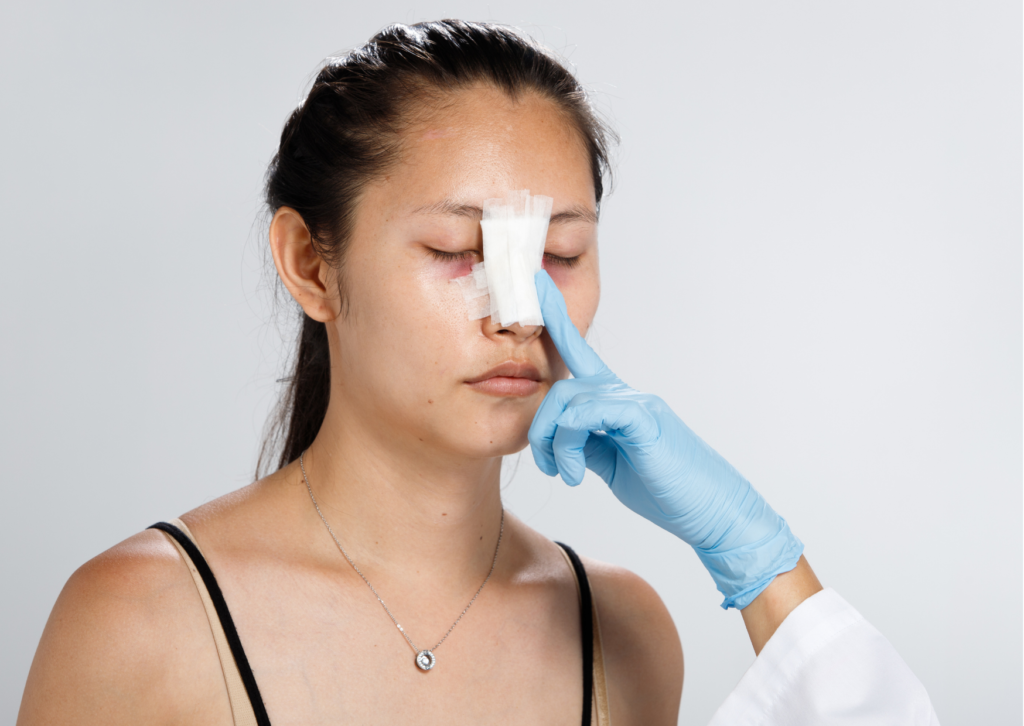
Does a Silicone Nose Implant Always Have to Be Removed?
It is important to know the possible side effects of silicone implants and to check on their condition regularly. But it is not appropriate to conclude that removal surgery is required just because 10 or 15 years have passed since the operation.
Because some implants remain stable without any particular problems, there is no need to decide on revision based only on the time elapsed since surgery.
Conversely, if the skin at the nasal tip is thinning, the implant is showing through, or you have pain and redness, do not dismiss it as a mere cosmetic change; see a doctor. In particular, if the skin has been broken or the implant is exposed, prompt medical evaluation is needed.
The safety of silicone nose implants and the need for revision vary from person to person. If you are considering rhinoplasty or an existing implant has caused problems, it is best to consult thoroughly with a plastic surgery specialist and then decide on the treatment suited to your condition.
👉 Recommended reading: ○○ You Should Know Before Facial Contouring Surgery
Discover more from Hospital & Health Insight Korea
Subscribe to get the latest posts sent to your email.


 Korean
 English
 Japanese
 Chinese (China)
 Chinese (Taiwan)
 French
 Spanish
 Hindi
 Indonesian
 Russian
 Mongolian
 Vietnamese
 Thai
 German
 Turkish
 Portuguese
 Italian
 Polish
 Arabic