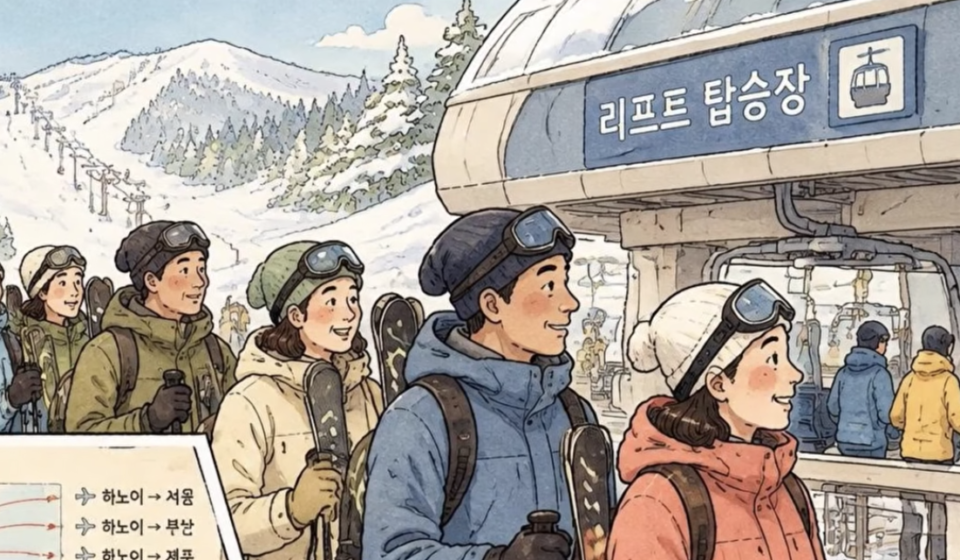
Why foreigners flock to Korean ski resorts: cheaper prices than Japan and easy access from Seoul

Last winter, people who had never seen snow in their lives lined up at Korean ski resorts. They were Vietnamese travelers. In front of them, ski packages to Korea and Japan were on sale side by side. Flight times from Hanoi were about five hours to both countries, so there was little difference. Yet the results were different: over one season, Vietnamese demand for ski trips to Korea rose about 40%, while trips to Japan grew only a little over 10%.
- Last season (2025/26), High1 Resort welcomed about 43,000 foreign visitors, up 54% from the previous year (about 28,000).
- Foreigners choose Korean ski resorts for lower prices than Japan, short distance, beginner facilities, easy links to Seoul and resorts’ long-running overseas marketing.
- Meanwhile, domestic ski resort visitors fell from about 6.86 million in the 2011/12 season to the 3 million range recently, and the number of ski resorts dropped from 17 to about 12.
In fact, High1 Resort in Gangwon Province said it welcomed about 43,000 foreign visitors last winter, up 54% from the year before. That is about 15,000 more foreign tourists in just one year. During Tết, Vietnam’s biggest holiday, some travelers even chose Korean ski resorts over time with family at home.
In Vietnam, Tết is a very important holiday when the whole family gets together. Recently, though, more people have been spending this precious holiday abroad, seeing snow and skiing. For Southeast Asian countries that almost never see snow, Korea’s winter scenery and ski resorts have become a new overseas travel product.
Lien Nguyen from Hanoi put on skis for the first time in her life. She fell as soon as she got on the slope, and fell several more times after getting up. But she did not give up and finally made it to the bottom of the slope on her own. She said racing down the snow for the first time was the most thrilling moment of the trip.
Experiences like this were repeated across Gangwon Province last winter. Local travel agencies say Vietnamese travelers increasingly choose destinations based on skiing and snow festivals. Traveling abroad to see snow over the holidays has started to become a new travel trend.
As Korean ski trips became popular, their prices drew attention too. Some Vietnamese travel agencies sold Korean ski packages for about 1.23 million won. That is not a small amount for local office workers, but Korea packages sold quickly from the end of last year. Some people who tried to book late could not travel at all because there were no seats left, even though they were willing to pay.
Why did Vietnamese travelers choose Korean ski resorts over Japan?
But one question arises here. When people think of ski trips in Asia, Japan comes to mind first. Hokkaido and Niseko, Nagano and Hakuba are famous areas skiers around the world want to visit at least once. Japan is known for its excellent snow, and its ski facilities and surrounding tourist infrastructure are well developed.
The Hakuba area alone has many ski resorts, and last winter it drew about 1.92 million visitors, the most in ten years. This shows that Japan’s ski resorts are still competitive on a global level.
So why did Vietnamese travelers choose Korea over Japan?
The answer can be found on the price tags of the travel packages.
Comparing ski packages departing from Ho Chi Minh City, Korea trips start at about 1 million won, while some Japan trips start at about 2.8 million won. For the same ski trip, Japan costs nearly three times as much as Korea. The price gap alone is about 1.8 million won.
For first-time skiers, something matters more than snow quality or global reputation: how easily and affordably they can try skiing on snow. If the cost of one trip to Japan could pay for several trips to Korea, Korea becomes a very attractive choice for consumers.
Ski resorts near Seoul: what makes them convenient?
Another advantage of Korean ski resorts is how close they are to Seoul.
A good example is Elysian Gangchon in Chuncheon. It is close enough to reach from Seoul by subway, and it offers ski rentals and lessons for beginners. You can learn to ski during the day and head to Seoul in the evening for shopping and good food.
In fact, from Sangbong Station in Seoul, the Gyeongchun Line subway or ITX-Cheongchun train reaches Elysian Gangchon Station (Baegyangni Station) in about an hour, and a free shuttle bus runs from the station to the resort. Being able to ski on a day trip without a rental car is a big advantage for foreigners visiting Korea on a short schedule.
For foreign tourists, Korean ski resorts are not just places to ski. They are part of an all-in-one trip that combines sightseeing in Seoul, shopping, food and Korean culture.
How did Korean ski resorts attract foreign tourists?
Korean ski resorts have been preparing for foreign visitors for a long time. High1 Resort began running ski events for Southeast Asian tourists about 18 years ago. It started with just 23 participants, but five years later the number had grown to 850. By combining ski lessons with Korean cultural experiences, it attracted tourists from Hong Kong, Singapore and other countries.
Later it also held separate snow sledding events for tourists from Thailand and Taiwan. Years of effort to attract foreign visitors are now paying off in recent growth.
Services for foreigners have also grown recently. High1 set up a one-stop service lounge just for foreigners at its ski area, ran one-day ski tours and attracted group tourists from the Philippines through charter flights to Yangyang International Airport. Note, however, that the 43,000 figure above counts foreign visitors to the whole High1 Resort, not just the ski area.
The Korea Tourism Organization has also actively promoted Korean winter travel in Southeast Asia and other key Asian countries for more than ten years. Through ads in places such as Manila in the Philippines and Jakarta in Indonesia, it introduced the charm of Korean winters to people from countries where snow is rare.
This trend is not limited to Vietnam. The main countries sending winter travelers to Korea include Taiwan, Singapore, Hong Kong, the Philippines and Malaysia. Most are places where people rarely see snow even in winter.
Vivaldi Park in Hongcheon also saw foreign tourists rise more than 50% last winter compared with the year before. Visitors from Singapore, Taiwan and Hong Kong were the main guests.
Mona Yongpyong in Pyeongchang created a snow theme park so that tourists who cannot ski can also enjoy the snow. The strategy is to move beyond a space only for good skiers and attract tourists experiencing snow for the very first time. Related sales rose after this change.
Across Gangwon Province as a whole, winter travel demand is substantial. About 35 million tourists visited Gangwon last winter, up 5.7% from the year before. Its winter scenery, ski resorts and snowy Nami Island are drawing interest from both foreign and domestic travelers.
Foreign visitors are up, so why are Korean skiers down?
Looking only at these numbers, it might seem that Korean ski resorts are enjoying a new golden age. Foreign tourists are increasing, resort sales are rising and the winter tourism market is lively.
But one important fact is missing from these numbers.
The number of Korean skiers is still not growing.
At Vivaldi Park in Hongcheon, foreign tourists increased sharply, but Korean visitors hardly changed over the past three years. More foreign tourists and a recovering domestic ski market are completely different things.
In the past, heading to a ski resort with friends when winter vacation began was a familiar scene. University students worked part-time at resorts in winter, and on weekends the roads to Gangwon were packed with cars carrying ski gear.
In the 2011/12 season, about 6.86 million people visited ski resorts nationwide, a record high. At the time, ski resorts were a top place for winter leisure.
But visitor numbers declined steadily after that. In the 2020/21 season, when COVID-19 was spreading, visitors to ski resorts nationwide fell to about 1.45 million, a sharp drop from the peak of 6.86 million.
The problem is that the old visitors did not return even after COVID-19 ended. Even in the 2019/20 season, when COVID-19 began, ski resort visitors numbered about 3.76 million, already close to half the peak.
Afterwards, the number reached about 3.73 million in the winter of 2022, but it has stayed in the 3 million range ever since. COVID-19 only sped up a decline that was already under way; it was not the root cause of the fall of Korean ski resorts.
| Season | Ski resort visitors nationwide | Notes |
|---|---|---|
| 2011/12 season | About 6.86 million | Record high |
| 2019/20 season | About 3.76 million | About half the peak |
| 2020/21 season | About 1.45 million | Sharp drop due to COVID-19 |
| Recent seasons | 3 million range | Slow recovery even after COVID-19 |
Source: news reports citing the Korea Ski Resort Business Association. The association has since stopped publishing visitor statistics, so recent figures are based on news reports.
The drop in visitors has led to actual ski resort closures.
About 17 ski resorts once operated across the country, but recently only about 12 run their lifts. Nearly one in three has disappeared.
The Alps Ski Resort in Goseong, Gangwon, stopped operating long ago. Its once-popular condos and facilities were abandoned, and weeds began to grow on what used to be slopes. There were attempts to reopen it, but the project never moved forward properly, and it remains like a ruin.

Some slopes at ski resorts in Taebaek have also been left unused for a long time.
The same thing happened in the Seoul metropolitan area. Ski resorts relatively close to Seoul, such as Star Hill Resort in Namyangju, Bears Town in Pocheon and Yangji Pine Resort in Yongin, stopped operating or closed their ski business.
When a ski resort disappears, local businesses suffer too. More rental shops, restaurants and guesthouses that relied on winter tourists have closed as customers dwindled.
So why are Korean ski resorts declining so fast?
1. Winters are getting shorter
The first reason is that winters are getting shorter.
In the past, some resorts opened in early November, but recently many open in early December on average. More resorts that used to run until early March now close at the end of February.
A shorter operating season means fewer chances to make money. When natural snow is lacking, resorts must make artificial snow, which costs electricity and equipment operation.
When temperatures rise and fall unpredictably, snowmaking becomes harder and the cost of maintaining lifts and facilities goes up. Climate change is putting direct pressure on ski resort operations.
2. Fewer new skiers
The second reason is that fewer new people are taking up skiing.
Most current visitors are in their 30s and 40s, but the number of children and teenagers who would become the next generation of skiers is falling.
Young people’s leisure has changed too. Skiing used to be the main winter leisure activity, but now there are many more options, such as camping, golf and overseas travel.
Some resorts offer free season passes for children to win new customers, but it is not easy to reverse the overall decline.
3. Skiing costs more
The third reason is the rising cost of skiing.
To ski, you have to pay not only for a lift ticket but also for equipment and clothing rental, transport and accommodation. For families, the cost is even higher.
As electricity and labor costs rise, resorts also find it hard to lower prices. In the end, consumers decide whether to go based on the total cost of a ski trip.

4. Overseas travel has become easier
The fourth reason is that overseas travel has become common.
Overseas travel used to be a special experience, but now people can compare flights and hotels and travel abroad fairly easily.
If a ski trip costs about the same as a trip abroad, consumers may choose a new destination.
Domestic ski resorts now compete not only with other ski resorts but also with overseas travel and many other leisure activities.
These changes show up in ski resort sales. High1’s winter ski revenue in the first quarter was about 15 billion won when visitor numbers were at their peak, but ten years later it fell to about 8.9 billion won for the same period, roughly 41% less.
Foreigners also flocked to Korean ski resorts during the IMF crisis 28 years ago
Interestingly, this is not the first time foreign tourists have flocked to Korean ski resorts.
About 28 years ago, during the winter of the IMF financial crisis, Korean ski resorts were also busy with foreign tourists.
At the time, the Korean won fell sharply, making trips to Korea relatively cheap for foreign tourists. Tourists from Hong Kong, Taiwan, Singapore and other parts of Asia began visiting Korean ski resorts.
In one month at that time, about 64,890 Southeast Asian tourists visited Korea. The Korea Tourism Organization even expected 200,000 foreigners to visit Korean ski resorts by the end of February that year.
Foreign arrivals through Gimpo Airport rose sharply around the Lunar New Year holiday in particular.
Back then, the biggest strength of Korean ski resorts was also price. A 6-night, 7-day Korean ski package from Singapore cost about 1.08 million won at the time, and being cheaper than Japan was the main selling point.
Even Japanese tourists came to Korean ski resorts, because traveling in Korea was cheaper than skiing in Japan.
Ski resorts popular with Southeast Asian tourists at the time included Jisan, Yongpyong and Bears Town. Bears Town, now closed, was once one of the main winter destinations welcoming foreign tourists.
Whether 28 years ago or now, the strengths of Korean ski resorts have not changed much: lower prices than Japan, a convenient distance for Asian tourists and an environment where first-time skiers can learn easily.
How are Japan’s ski resorts different?
This does not mean Japanese ski resorts are declining. Japan’s Hakuba area drew about 1.92 million visitors last winter, its highest in ten years. Meanwhile, some areas such as Niseko in Hokkaido saw fewer lift rides, showing differences by region.
Japan also faces a long-term decline in its domestic ski population. As overseas visitors make up a larger share, foreign tourists are becoming an important source of revenue, much like in Korea.
The mix of visitors is different, though. Japan attracts skiers from many countries, including Western countries and Australia, while Korea’s main customers are tourists from Asian countries where snow is rare.
5 reasons foreigners choose Korean ski resorts
What matters here is why foreign tourists choose Korean ski resorts.
Foreigners do not visit Korean ski resorts simply because the resorts are especially outstanding. It is the combined result of relatively low prices, short travel distances, lessons for beginners and the convenience of combining the trip with sightseeing in Seoul.
- Lower prices than Japan: From Ho Chi Minh City, Korea ski packages start at about 1 million won, while some Japan packages start at about 2.8 million won.
- Short distance: It is about a five-hour flight from Vietnam, Taiwan, Hong Kong, Singapore and other places, and ski resorts are 1–3 hours from Seoul.
- Beginner-friendly: Equipment and clothing rentals and beginner lessons are well established, so even people seeing snow for the first time can start learning right away.
- Easy to combine with Seoul: Ski during the day and enjoy shopping and food in Seoul in the evening, all in one trip.
- Resorts’ long-running overseas marketing: High1 has been attracting Southeast Asian tourists for about 18 years, and resorts now target non-skiers too with snow theme parks and foreigner lounges.
How long can these strengths last?
The problem is that these strengths will not last forever.
Vietnamese travel agencies still sell ski packages to Korea, China and Japan side by side. If another country offers cheaper and more convenient packages, tourists can change their choice at any time.
Exchange rates also change how expensive Korea feels to foreigners. If Korean ski resorts rely only on foreign tourists, demand could swing sharply with exchange rates and the overseas travel market.
In addition, the rise in foreign tourists tends to be concentrated at large resorts such as High1, Vivaldi Park and Mona Yongpyong. Ski resorts that have already closed, and the businesses around them, will not recover on their own.
There are still many challenges to solve before we can say Korean ski resorts as a whole have revived.
Positive changes at Korean ski resorts
Even so, positive changes are appearing.
Mona Yongpyong built a snow theme park that tourists who cannot ski can enjoy, and High1 has built up 18 years of experience attracting Southeast Asian tourists.
Ski resorts near Seoul are actively welcoming foreign tourists experiencing snow for the first time by improving equipment rental, beginner lessons and transport access.
Ski resorts are changing from places only good skiers visited into winter destinations that even people seeing snow for the first time can enjoy.
Winter travel packages with stays of several days in Gangwon are also increasing. If more tourists stay overnight, eat and visit nearby attractions instead of skiing for a day and leaving, local businesses could benefit as well.
In the end, for Korean ski resorts to grow again, they need a strategy that both attracts foreign tourists and brings domestic skiers back.
Ski resort visitors, who once reached 6.86 million, are now in the 3 million range. Of the 17 ski resorts once operating nationwide, only about 12 operate today.
Meanwhile, Vietnamese demand for ski trips to Korea rose about 40%, and foreign visitors to High1 Resort increased 54% to about 43,000.
The rise in foreign tourists is clearly positive. But unless the domestic skiers who once filled Korean ski resorts come back, it is hard to call it a full revival.
For people from countries without snow, Korea is a cheap, close and convenient winter destination. But for Koreans themselves, skiing is becoming an increasingly expensive and burdensome winter pastime.
Getting foreign tourists who stepped on snow for the first time to come back is important, but so is creating an environment where Koreans who once enjoyed skiing can return.
What foreigners should know before visiting a Korean ski resort
Frequently Asked Questions
Q. How much cheaper are Korean ski resorts than Japan?
A. Based on travel packages from Ho Chi Minh City, Korea started at about 1 million won and some Japan packages at about 2.8 million won, a gap of up to nearly three times. It depends on the package and exchange rates, though.
Q. Which ski resort is easiest to reach from Seoul?
A. Elysian Gangchon, which you can reach by subway, is the best-known example. Take the Gyeongchun Line from Sangbong Station, get off at Elysian Gangchon Station (Baegyangni Station) and take the free shuttle bus.
Q. Is it okay if I have never skied before?
A. Yes. Most resorts have equipment rental, beginner lessons and beginner slopes, and many foreign tourists ski for the first time there.
Q. Are Korean ski resorts really reviving?
A. Foreign visitors are increasing, but domestic visitors remain in the 3 million range, so it is still too early to say the industry as a whole has recovered.
Can Korean ski resorts really revive on foreign visitors alone?
Korean ski resorts are now facing a new opportunity. Whether the rise in foreign tourists ends as a passing trend or becomes a new growth engine for Korean winter tourism depends on what happens next.
Can Korean ski resorts survive on foreign tourists alone? Or will the day come when the Koreans who left return to the slopes?
The true revival of Korean ski resorts will be complete only when not just foreign tourists increase but domestic ski culture comes back to life as well.
References
Discover more from Hospital & Health Insight Korea
Subscribe to get the latest posts sent to your email.



 Korean
 English
 Japanese
 Chinese (China)
 Chinese (Taiwan)
 French
 Spanish
 Hindi
 Indonesian
 Russian
 Mongolian
 Vietnamese
 Thai
 German
 Turkish
 Portuguese
 Italian
 Polish
 Arabic