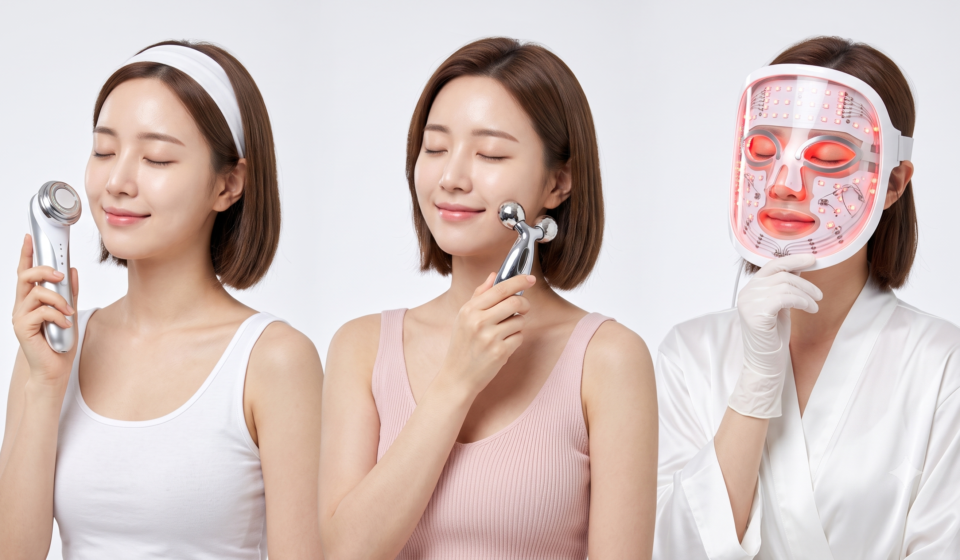
Complete Guide to Korean Home-Care Skin Lifting Devices
Complete Guide to Korean Home-Care Skin Lifting Devices
Interest in at-home lifting devices has been exploding in Korea lately.
With technologies such as radiofrequency, HIFU, EMS and LED all on the market, the message that "you can get a lift at home" is everywhere, yet accurate information about how well these devices actually work and how to use them safely is still scarce.
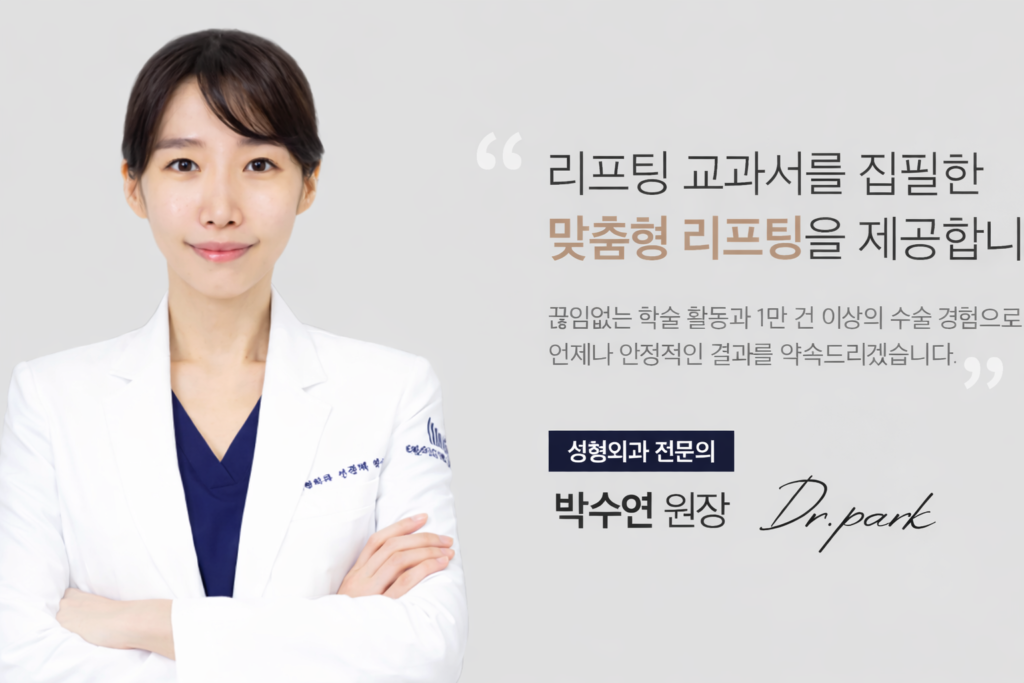
So, based on what we confirmed directly with Dr. Park Su-yeon, a plastic surgery and dermatology specialist at Made Young in Korea, we have summarized how at-home lifting devices work and how to use them correctly.
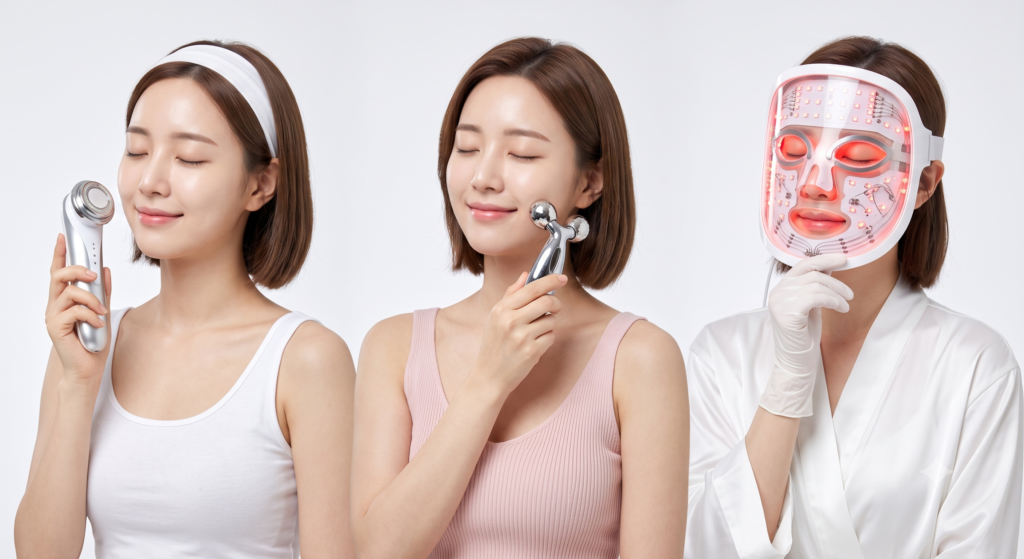
🔥 1. Radiofrequency & HIFU — the core technologies that wake up collagen
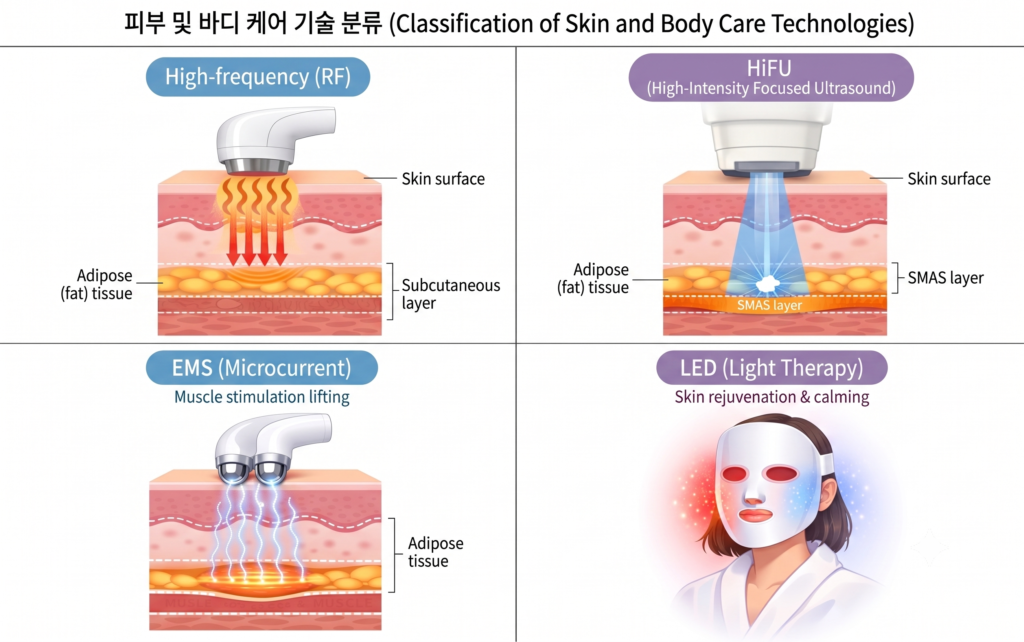
✔ Radiofrequency (RF)
Gently heats the dermis to stimulate collagen regeneration
Helps improve skin elasticity, double chin and sagging
Almost painless, so even sensitive skin can use it
Popular devices: Cellume, medicube AGE-R
✔ HIFU
Delivers energy deeper than radiofrequency, down to the SMAS layer (4.5mm)
The same target layer as in-clinic lifting treatments
Effective for sagging cheeks, the jawline and contour lifting
Popular devices: Infinity, Lukins, Homethera, Nuzmi
Caution: because the intensity is high, overuse can cause side effects
⚡ 2. EMS — a lifting method that stimulates muscles directly
EMS works by stimulating the facial muscles directly rather than the skin layers.
Right after use, contours look more defined and puffiness goes down
Improved blood flow makes the face look more lively
Popular devices: NuFACE, FOREO BEAR
Works faster for people who tend to wake up puffy
But daily use is a no-go.
Muscles can also become fatigued, sore or stiff when overstimulated, so using it 3–4 times a week or every other day is safest.
💡 3. LED — safe, but "too much does harm"
LED is relatively safe:
Red LED → elasticity and collagen
Blue LED → breakouts and sebum
Even sensitive skin can use it without much worry.
However, long or daily light stimulation can cause
dryness,
redness,
a feeling of heat,
and increased sensitivity,
so 10–15 minutes, 1 session a day, is about right.
🔍 4. Why shouldn't you use at-home devices every day?
This is the point Dr. Park emphasized most.
"Skin improves when it goes through a cycle of stimulation → recovery → improvement."
In the end, a device is a tool that stimulates the skin.
When stimulation keeps building up without recovery,
increased inflammation,
collagen breakdown,
loss of elasticity,
and accelerated long-term aging
can occur.
Being designed weaker than clinic equipment absolutely does not mean it is fine to use every day.
In fact, using a weak device every day can sometimes be even riskier.
Remember that at-home devices are not a replacement for clinic treatments but a supplementary form of care.
❓ FAQ — the most frequently asked questions
1) Can at-home devices alone match the results of clinic treatments?
→ The principles are similar, but the intensity and depth differ, so identical results are hard to achieve.
2) Which is better, radiofrequency or HIFU?
→ They serve different purposes.
Radiofrequency → elasticity and skin texture
HIFU → contouring and sagging
3) Why shouldn't I use them every day?
→ If only stimulation builds up, the skin cannot recover, which can lead to redness, puffiness, loss of elasticity and inflammation.
4) Can I use EMS every day?
→ Because of possible muscle fatigue, soreness and stiffness, every other day or 3–4 times a week is appropriate.
5) Are LED masks safe?
→ They are relatively safe, but excessive light stimulation can cause dryness and redness, so 10–15 minutes is the right amount of time.
Discover more from Hospital & Health Insight Korea
Subscribe to get the latest posts sent to your email.



 Korean
 English
 Japanese
 Chinese (China)
 Chinese (Taiwan)
 French
 Spanish
 Hindi
 Indonesian
 Russian
 Mongolian
 Vietnamese
 Thai
 German
 Turkish
 Portuguese
 Italian
 Polish
 Arabic