Skip to content
-
Subscribe to our newsletter & never miss our best posts. Subscribe Now!
Hospital & Health Insight Korea

Korean hospital & medical tourism information for international visitors

Hospital & Health Insight Korea

Korean hospital & medical tourism information for international visitors

  • HH inside Korea
    • Plastic Surgery
    • Dermatology
    • Orthopedics
    • Dentistry
    • Internal Medicine
    • OB-GYN
    • Korean Medicine
    • Cancer Center
  • KHospital info
  • Language Guide 18
    • 🇺🇸 USA (En)
    • 🇯🇵 Japanese (JA)
    • 🇨🇳 Chinese (Zh-CN)
    • 🇹🇼 Chinese (Zh-TW)
    • 🇫🇷 French (FR)
    • 🇲🇽 Spanish (ES-MX)
    • 🇮🇩 Indonesian (ID)
    • 🇮🇳 Hindi (HI)
    • 🇻🇳 Vietnamese (VI)
    • 🇹🇭 Thai (TH)
    • 🇷🇺 Russian (RU)
    • 🇲🇳 Mongolian (MN)
    • 🇩🇪 German (DE)
    • 🇹🇷 Turkish (TR)
    • 🇵🇹 Portuguese (PT)
    • 🇮🇹 Italian (IT)
    • 🇵🇱 Polish (PL)
    • 🇸🇦 Arabic (Gulf dialect, Ar الخليجية)
  • If You Come to Korea
Subscribe
Plastic Surgery

Strip vs. Non-Incision Hair Transplant Scars: Recovery and Key Differences

2 Min Read
0

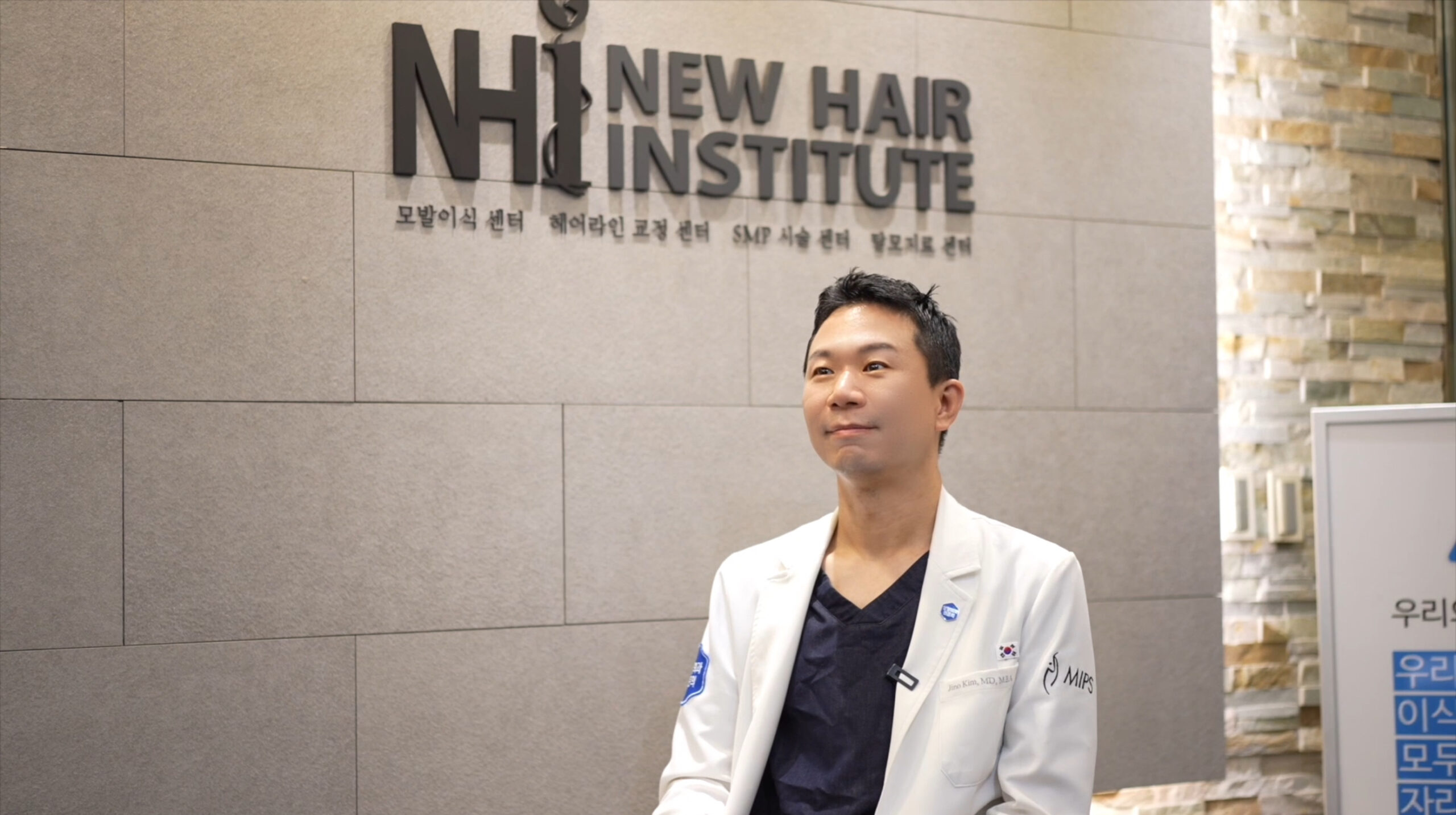
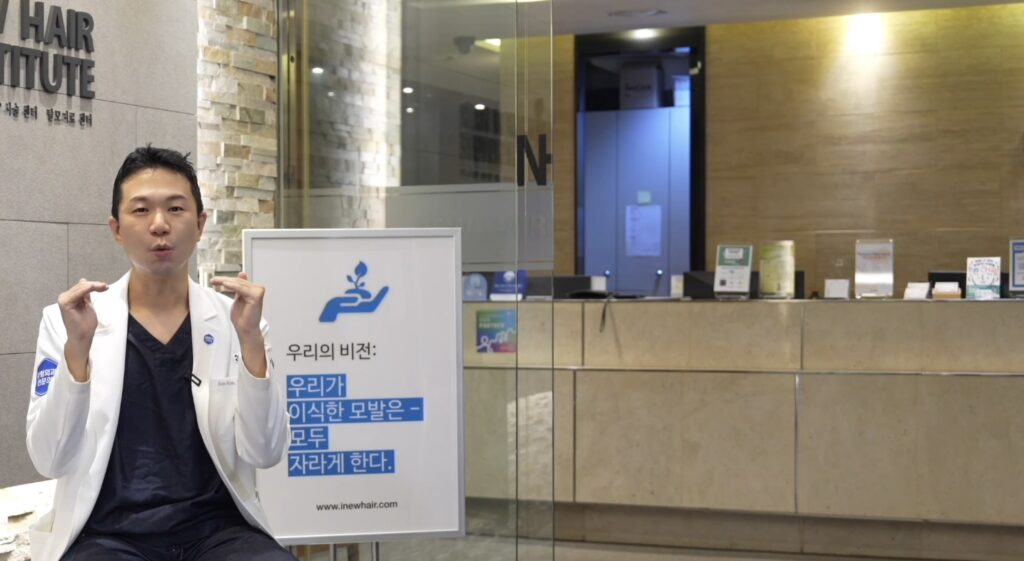
Today we interviewed Dr. Kim Jin-o, Medical Director of New Hair Transplant Center in Gangnam, Seoul, South Korea! Using real cases of incision (FUT) and non-incision (FUE) hair transplants, Dr. Kim explained in detail how the two methods differ and how scars heal.
Strip vs. Non-Incision Hair Transplant Scars: Recovery and Key Differences

When does an incision hair transplant scar become less visible?

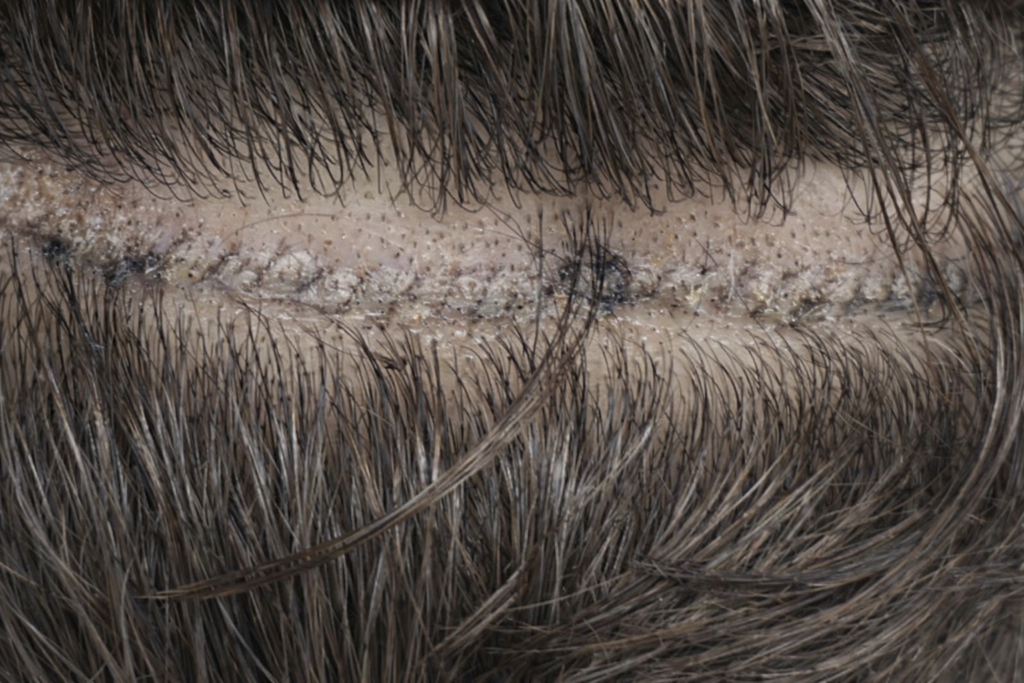
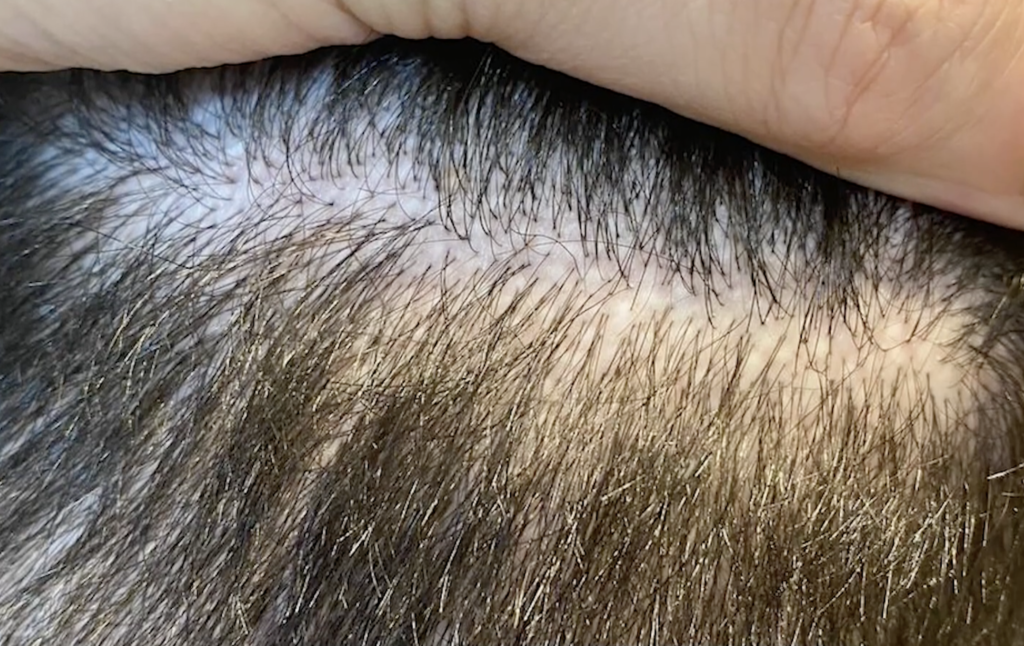
Dr. Kim: Let's take a close look at how scars heal after incision and non-incision hair transplants. First, the incision method. This is the traditional hair transplant method. If you look at the photo, you can see a single line running across the back of the scalp.
Strip vs. Non-Incision Hair Transplant Scars: Recovery and Key Differences

This line is the mark left after the incision was stitched closed. Right after surgery the stitches are still in, so it may look a little unfamiliar, but once they are removed, only a thin, line-shaped scar remains.
The incision site heals faster with ointment, so we advise most patients to apply ointment every day.
Patients who live alone apply it themselves, while those with family or a spouse sometimes get help.
Strip vs. Non-Incision Hair Transplant Scars: Recovery and Key Differences

Many patients tell us it was "stitched up really carefully," and that is because we use plastic surgery suturing techniques.
In plastic surgery, a double-layer suturing method is used: the soft tissue (the soft tissue beneath the skin) is first tied from the inside, and then the surface is stitched again from the outside. This approach minimizes scarring and helps the wound heal smoothly.
About 1 year after the stitches are removed, the scar fades to the point of being barely noticeable.
Strip vs. Non-Incision Hair Transplant Scars: Recovery and Key Differences

What do non-incision hair transplant scars look like?

Non-incision hair transplantation is a method in which follicles are extracted one by one without any incision.
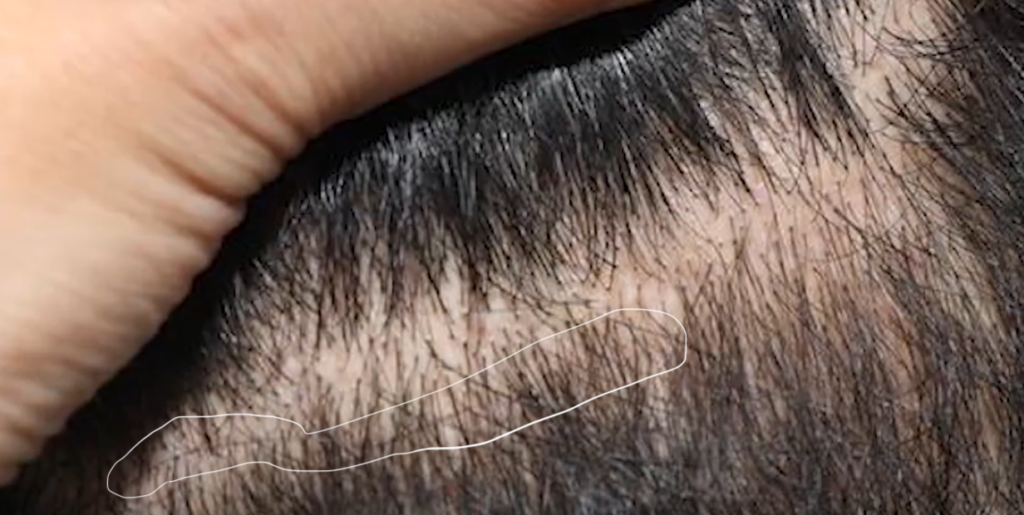
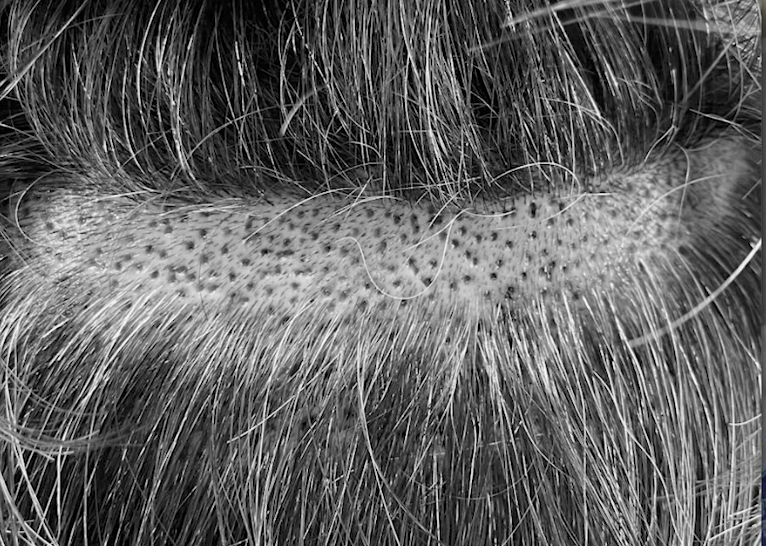
Right after surgery, you can see lots of tiny holes dotted across the scalp; these are the spots where the hair was harvested.
People with trypophobia may find this a bit uncomfortable, but these holes fill in naturally over time.
In the non-incision method, the entire follicle is harvested with a cylindrical punch, so hair does not grow back in the extraction sites.
In other words, this is because the follicle is harvested all the way down to its root.
For this reason, only about 30-40% of the total hair is harvested, and the remaining 60% must be left in place so the back of the head does not look patchy.
Strip vs. Non-Incision Hair Transplant Scars: Recovery and Key Differences

As healing progresses, the hole marks become small, and up close you may see tiny dot-shaped scars.
These dots may show if the hair is cut very short or shaved, in which case they can be naturally concealed with scalp micropigmentation (SMP).
Strip vs. Non-Incision Hair Transplant Scars: Recovery and Key Differences

As healing progresses, the hole marks become small, and up close you may see tiny dot-shaped scars.
These dots may show if the hair is cut very short or shaved, in which case they can be naturally concealed with scalp micropigmentation (SMP).

Here is a summary of the interview, which was conducted while reviewing patient photos.

  • Incision method (FUT): leaves a linear scar, but depending on the suturing technique it can heal to be barely noticeable.
  • Non-incision method (FUE): leaves tiny dot-shaped scars, which may show if the head is shaved.
  • With proper care and treatment, scars from either method gradually fade and do not greatly affect daily life.

The interview above was recorded for a video production, and the New Hair website is https://newhairps.com/ .

👉 Recommended reading: Interview Summary on Scar Differences Between Incision and Non‑Incision Hair Transplant Methods in Korea

Share this article

Related


Discover more from Hospital & Health Insight Korea

Subscribe to get the latest posts sent to your email.

Tags:

Korea Hair Transplant Clinic
Author

SSJ

Operator of BBB · Hospital Health Insight Korea. Since 2009 I have managed the Naver café “Byeongwon Balpum Baekgwa Daesajeon,” running a community that has shared Korean hospital information for 17 years. After experiencing high costs and inconvenient systems at hospitals abroad, I organize information on Korean hospitals, health checkups, plastic surgery and skin treatments in 18 languages so foreigners can find it easily.

Follow Me
Other Articles
Next

5 Reasons You Should Visit Busan

No Comment! Be the first one.

Leave a Reply Cancel reply

Your email address will not be published. Required fields are marked *

Get the latest on Korean hospitals and dental clinics

We’ll email you new information on costs and hospitals. You can unsubscribe at any time.

Categories

  • HH inside Korea
  • KHospital info
  • Internal Medicine
  • If You Come to Korea
  • OB-GYN
  • Plastic Surgery
  • Cancer Center
  • Dentistry
  • Dermatology
  • Korean Medicine
Copyright 2026 — Hospital & Health Insight Korea. All rights reserved. Blogsy WordPress Theme
We've detected you might be speaking a different language. Do you want to change to:
Change language to Korean Korean
English
Change language to Japanese Japanese
Change language to Chinese Chinese (China)
Change language to Chinese Chinese (Taiwan)
Change language to French French
Change language to Spanish Spanish
Change language to Hindi Hindi
Change language to Indonesian Indonesian
Change language to Russian Russian
Change language to Mongolian Mongolian
Change language to Vietnamese Vietnamese
Change language to Thai Thai
Change language to German German
Change language to Turkish Turkish
Change language to Portuguese Portuguese
Change language to Italian Italian
Change language to Polish Polish
Change language to Arabic Arabic
Change Language
Close and do not switch language
English
Korean Japanese Chinese (China) Chinese (Taiwan) French Spanish Hindi Indonesian Russian Mongolian Vietnamese Thai German Turkish Portuguese Italian Polish Arabic