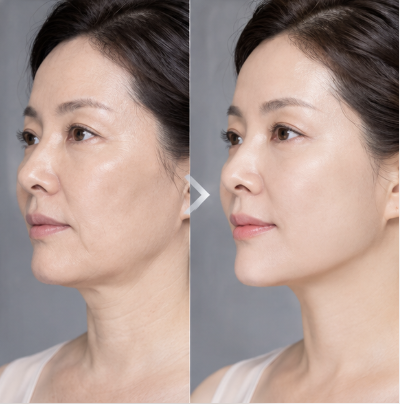
When Does Facelift Swelling Go Down? Recovery Timeline from Surgery to 6 Months
Many people worry that something has gone wrong with their surgery when their face looks very swollen and wide after a facelift. However, because a facelift involves separating the skin and facial tissue, then pulling and securing them, swelling, bruising, tightness, and reduced sensation can appear right after surgery. These symptoms can occur during recovery, and how quickly the swelling subsides and when the final results appear vary from person to person.
When is swelling at its worst after a facelift, and when does the face start to look natural again? Let's look at the changes that can occur from right after surgery through the following months, and what to watch for during recovery.
1. From right after facelift surgery to day 2
Right after a facelift, you may wear a compression bandage on your face, and depending on the extent of surgery and the clinic's policy, drains may also be placed. Your face may feel tight or compressed, and swelling may appear around the eyes, cheeks, and jawline.
After surgery, swelling and bruising gradually begin to appear, and you may feel stiffness when opening your mouth wide or moving your face. During this period, it is important not to judge the final result based only on how your face looks right after surgery.
When drains and compression bandages are removed depends on the surgical method, the amount of bleeding, and your recovery. Do not remove the bandage on your own or touch the wound area; follow your medical team's instructions.
2. Days 3-4 after a facelift: when swelling is at its worst
Swelling after a facelift generally can increase for several days after surgery, and it often feels worst during the first 2-4 days. At this point, your face may look wider than usual or your cheekbones may appear prominent, and swelling and bruising may spread to the jawline and neck area.
Your facial skin may feel tight, and the area around your ears may feel firm. These changes can result from postoperative edema and tissue healing, but you should not assume that every symptom is a normal recovery response.
In particular, contact the clinic where you had surgery immediately if one side of your face suddenly becomes very swollen, pain rapidly worsens, or bleeding or changes in skin color appear. Worsening fever, redness, or warmth should also be checked by your medical team.
How to manage facelift swelling
First, it is best to sleep with your head slightly higher than your heart. Elevating your upper body appropriately during sleep can help manage swelling.
Second, cold compresses should be applied according to the method and duration your medical team recommends. Avoid placing ice directly on the surgical area or pressing on it firmly.
Third, light walking within your limits can help recovery. However, avoid strenuous exercise, and it is best to refrain from activities that raise body temperature, such as hot compresses or half-body baths, until your medical team allows them.
Fourth, do not repeatedly press or pull on your nose or face. Frequently touching the surgical area to check your recovery can cause unnecessary irritation to the tissue.

3. Days 4-7 after a facelift: when swelling gradually decreases
By about 4-7 days after surgery, the severe early swelling may begin to subside little by little. However, swelling does not decrease evenly day by day, and it may differ between morning and evening.
During this period, your face may still look swollen or you may notice asymmetry between the left and right sides. As swelling and bruising move toward the lower cheeks, chin, and neck, your face shape may look different than usual.
When stitches are removed depends on the surgical method, incision site, and how the wound is healing. Some stitches may be removed first and the rest in stages, and complete removal can take about 1-2 weeks.
Having your stitches removed does not mean recovery is complete. To help the wound heal stably, follow your medical team's instructions and avoid large facial movements or actions that put strong force on the wound area.
4. Weeks 1-2 after a facelift: returning to daily life
After 1-2 weeks, the early swelling and bruising often decrease noticeably and your facial contours gradually begin to show. Depending on the person, light outings and daily activities may become possible, but residual swelling and tightness may remain.
Even during this period, be careful about opening your mouth excessively wide or moving your neck and face forcefully. Strenuous exercise and activities that could cause impact to the face should be resumed with the condition of the wound and tissue recovery in mind.
Compression garments such as facial bands are not needed in the same way by every patient. Whether to wear one and for how long should be determined by the surgical method and your medical team's instructions.
5. 1 month after a facelift: why the face can look wide
By 1 month after a facelift, the early swelling may have decreased considerably, but it is still too early to judge the final result. The tissue beneath the skin is still healing, and residual swelling, changes in sensation, and a feeling of tightness may remain.
Some people are especially concerned that their face looks wide or that their cheekbones look prominent. Because a facelift repositions sagging facial tissue upward, the overlap of early swelling and the change in tissue position can make the cheekbone area look relatively emphasized.
This appearance may ease as swelling decreases, but it does not resolve naturally in every case. If asymmetry or changes in contour continue to feel severe, it is a good idea to have your condition checked at the clinic where you had surgery.
Dull sensation or firmness around the ears after surgery can also occur during recovery. However, since sensation can take several months to return, the degree of your symptoms and how they change should be reviewed with your medical team.
6. Months 3-6 after a facelift: when scars and tissue stabilize
For up to about 3 months after a facelift, the area around the ears or neck may feel firm, or the skin may feel tight. This may be related to scar tissue and the healing of the surgical area.
Over time, scars can gradually soften and their redness can fade. However, how quickly scars stabilize depends on skin characteristics, the extent of surgery, your constitution, and how they are cared for, and scar maturation can take from 6 months to 1 year or longer.
An uneven-looking skin surface can also appear temporarily because of swelling and tissue changes. However, if the unevenness worsens or persists, it should be checked to determine whether it is simply swelling or has another cause.
During this period, you can gradually resume exercise depending on your physical condition and degree of recovery. However, it is safer to start heavy lifting or high-intensity activities only after checking with your medical team.
7. What are the effects of a facelift, and how long do they last?
The purpose of a facelift is to improve the jawline and facial contours by repositioning sagging skin and the face's supporting tissues. However, swelling and bruising make it hard to see the actual result right after surgery, and facial contours gradually become more natural as recovery progresses.
When the results stabilize varies from person to person, but changes can continue over several months. For this reason, it is best not to draw conclusions about the final result based only on how you look about 1 month after surgery.
How long facelift results last also depends on the surgical method and extent, skin condition, rate of aging, lifestyle habits, and other factors. The effects can last a long time, but aging does not stop, so the same duration cannot be applied to every patient.

Facelift swelling: don't rush, keep track of your recovery
Swelling after a facelift usually increases from right after surgery and can become severe during the first few days, then gradually decreases over the following weeks. However, residual swelling, changes in sensation, and scar firmness can continue for several months.
Because recovery speed differs from person to person, it is best not to simply compare your condition with another patient's recovery. It is important to get plenty of rest, follow your postoperative precautions, and check your recovery through regular follow-up visits.
Above all, if you experience sudden severe swelling, worsening pain, persistent bleeding, fever, or changes in skin color, do not wait assuming it is part of recovery; have your medical team check it immediately. Since recovery from a facelift takes time, it is important to prioritize safety and recover step by step.
How to make facelift results last longer Recommended reading https://hospitalhealthinsightkor.com/ponytail-lift/
Discover more from Hospital & Health Insight Korea
Subscribe to get the latest posts sent to your email.



 Korean
 English
 Japanese
 Chinese (China)
 Chinese (Taiwan)
 French
 Spanish
 Hindi
 Indonesian
 Russian
 Mongolian
 Vietnamese
 Thai
 German
 Turkish
 Portuguese
 Italian
 Polish
 Arabic